Sushi Anaba – Copenhagen, Denmark

Updated: May 8
Now that I'm settled in my new digs in Atlanta, I can complete my hotly-anticipated reporting on an unapologetically decadent week in Copenhagen for my sister's wedding and start to give both my loyal readers a glimpse into the food-iverse in my new city.
Alone for one more night in the Danish capital, I continued my exploration of the glorious marriage between Asian and New Nordic foodways with a distinctly Nordic play on sushi omakase.

Anaba was quite high on my list during my first visit. My few but faithful regular readers are doubtless familiar with my penchant for omakase, and Anaba's focus on the bounty of the cold seas surrounding Scandinavia and infusion of Nordic ingredients and techniques into traditional edomae sushi was irresistible. It was the place I most regretted missing on my last visit and the first reservation I made in the city this time around.
Legend around Anaba says that Mads Battefeld holds the distinction of being the only European to work in sushi-ya in the Ginza district of Tokyo. Battefeld first discovered Japanese cuisine in Barcelona, of all places, and after studying the craft of Japanese foodways and finding the Japanese fare, and particularly sushi, in Europe sorely lacking, decided he had to work and study in Japan to learn the craft of an itamae.

After his time working and studying with masters in Japan, Battefeld could have worked anywhere, but chose to return to his native Denmark to become one of the only purveyors of high-end edomae sushi in the country, emphasizing classic Japanese technique applied to Danish and other Nordic seafood and regional ingredients. It's a truly unique establishment, unlike any other in Copenhagen, and I couldn't wait to sample it.
As is so often the case in Denmark, the space is as remarkable as the food––the old Customs House at the furthest extremity of an island in Copenhagen's Nordhavn district was taken apart brick by brick in 2019 and then reassembled painstakingly in the original design five years later. Today, it's home to Mads-san's beautiful Scandinavian Douglas fir sushi counter, where I'd settle in ready for a fabulous omakase.
Par for the course for Copenhagen, it had already been a day of wonderful seafood. For lunch, I made a chilly stroll (or hobble) across the train tracks to Kødbyens Fiskebar, about the furthest I could walk with my wounded right leg, and went to town on a handful of sensational seafood dishes. Particularly excellent (and Danish) was local brill with rye crumble.
Mercury poisoning, commence!
Like Koan the night before, Anaba is at the furthest reaches of a pier on the north end of town, and I confused yet another cabbie trying to find the building. It took me a few chilly minutes of meandering to locate the old customs house, and once I did, I settled in to their beautiful, oh-so-hygge lounge with fellow diners to await my omakase experience.

The omakase space itself is a continuation of the hygge vibe of the lounge––blonde wood, warm lighting, and just cozy enough. To my right was a gaggle of unfriendly fellow Yankees and to my left a couple of delightful Japanese Danes. Before me were a handful of statuesque Danes, many with pristine manbuns, in robes, including Mads-san himself.

Flavien Nowack is one of the most exciting figures in the new guard of grower Champagne vignerons, and I was delighted to see one of his bottlings offered as the first of the pairings for the night––Anaba offers a "mixed" pairing of wine and sake for a fairly reasonable price by Copenhagen standards, and starting with Nowack was certainly a power move.

Flavien tends family parcels around Vandières, about as far west in the Marne Valley as you can find any serious concentration of renowned grower-producers. His Autre Cru combines Meunier from multiple vineyards, offering a compelling on-ramp to his fascinating, vinous style of Champagne. A welcome first sip, indeed.
Just as brill started my lunch, it would start my dinner––kombu-cured brill was rolled around chives and shiso and dressed with a cured egg yolk sauce. Danish mullet roe in the vein of bottarga finished off a snappy, but intensely savory opening bite.

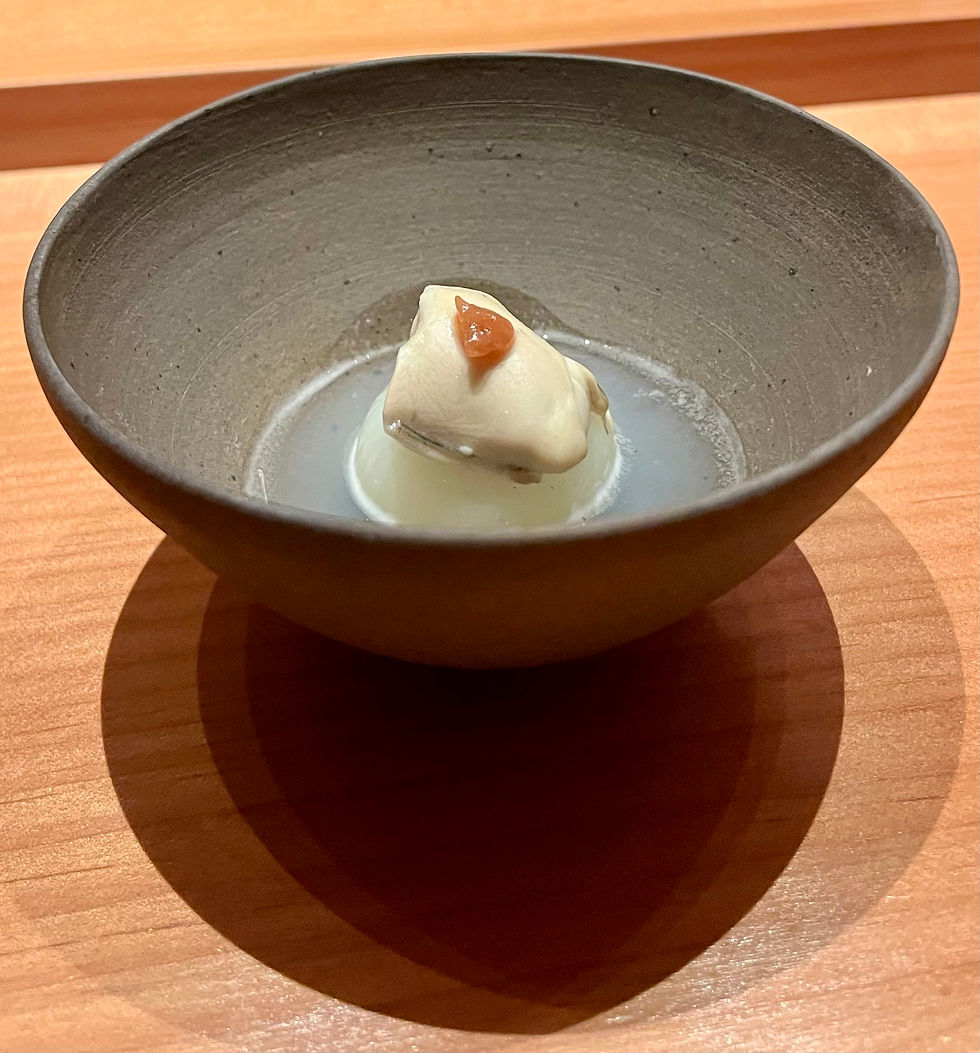
An oyster from the Normandy coast poached in sake came next, atop a melty sweet onion braised in the same liquid. Most impressive, however, was a take on umeboshi, traditionally a pickled plum condiment, made with Danish apricots harvested in the summer of 2024, a tiny dollop of which topped the mollusk.
Last among the introductory prepared dishes was gloriously sweet lobster from the brackish waters surrounding Denmark served alongside Japanese eggplant in a creamy dashi. Peppery sansho leaf completed the complex, decadent bite. The shellfish, particularly crustaceans, from this part of the world are mind-boggling.

The first flight of nigiri was on deck, along with a sake of which I failed to take a photo. As previously mentioned, nigiri at Anaba will include a smörgåsbord of incredible Scandinavian seafood:
A snappy cut of local whiting
Suzuki, or sea bass
Tiny Norwegian fjord shrimp, so sweet and delicate they'd put spot prawns to shame
Ika, the squid's flesh shaved into a sort of noodle and formed back together to achieve a melty texture, with sudachi zest and a hint of salt

Another sake was offered within the first set of nigiri. Produced by Mitobe Sake Brewery in Yamagata, this delightfully vibrant and aromatic sake is crafted with dewa san san rice grown by toji Asanobu Mitobe. It's quite rare to find sakes brewed using rice grown by the house, but the increasing focus on farming and terroir in winemaking has started to influence sake production, and is making such sakes quite famous worldwide.

Wrapping up the first parade of nigiri were three bites:
The almost comically petite heads of the fjord shrimp, deep fried
A lump of sweet Norwegian brown crab
A pristine scallop dusted with yuzu rind
Mark Haisma is a fantastic, cult-status producer in Burgundy, not unlike Flavien Nowack in Champagne, and his wines are electric. Saint-Romain, a tiny enclave tucked behind the Côte d'Or in a small valley, is benefitting from the increasing emphasis on "small" wines in Burgundy, often highlighting villages that have until now been rather under-the-radar. Saint-Romain's penchant for structured, mineral chardonnays has made the wines from this region a favorite among Burgundy fans and sommeliers alike, and it would prove to be a perfect companion to the richer prepared dishes to follow.

The next bite was a glorious exercise in decadence––unseasoned sushi rice was topped with melty chutoro, ossetra caviar cured with white truffles, and a cured quail egg yolk, all graced with a slice of white truffle. Never thought I'd be disappointed with a white truffle, but after a week devouring fragrant Alba truffles in Italy, I found this one, from Croatia, to be pretty anemic. Still, the remaining ingredients were almost hedonistically flavorful, and I relished every bite.

I learned on this visit to Copenhagen that Sweden is the source of some of the best wild freshwater eel in the world. I wonder if Sweden's most famous chef used them in his fishie chowder?
Slices of grilled Swedish eel were brushed with a sauce made from sansho leaf and peppercorn and served alongside pickled cucumbers from the Gunma Prefecture in Japan. Eel is a marvelous protein and becomes remarkably tender when slow-cooked, and the cucumbers provided a welcome, snappy foil to the rich, spicy flesh.

Mushrooms can form just as gorgeous a centerpiece for a dish as any protein, and these shiitakes were (if I recall correctly) stuffed with a sort of farce of cod and lobster claw meat. Grated yuzu rind provided an aromatic and tangy complement, while a dashi roasted with "new onions" formed the sauce.

I was thrilled to see a platter of sliced bluefin tuna being toured around the sushi bar and figured that nigiri was next.

But first, I'd be treated to a little show for my next sake. Each party was presented with a small metal pitcher complete with housing for a tea light candle beneath to keep the upcoming sake warm. Warm sake, indeed, is something with which I'm broadly inexperienced, but I'm quickly learning from my new coworker, a sake expert, how wonderful warmed sake can be.

Umami-driven and rich sakes usually benefit the most from warm serving temperatures, and Fudoh Yamahai Junmai is one such robust sake brewed in Chiba Prefecture by Nabedana Brewery. The sake was a perfect pairing with the richer dishes, with earthy, savory, and lactic flavors produced via the traditional slow-fermentation Yamahai method.

The second round of nigiri included the following:
Danish herring flash-smoked with hay and served with chives. How Scandinavian!
Bluefin chutoro
Bluefin otoro
Bluefin akami, marinated
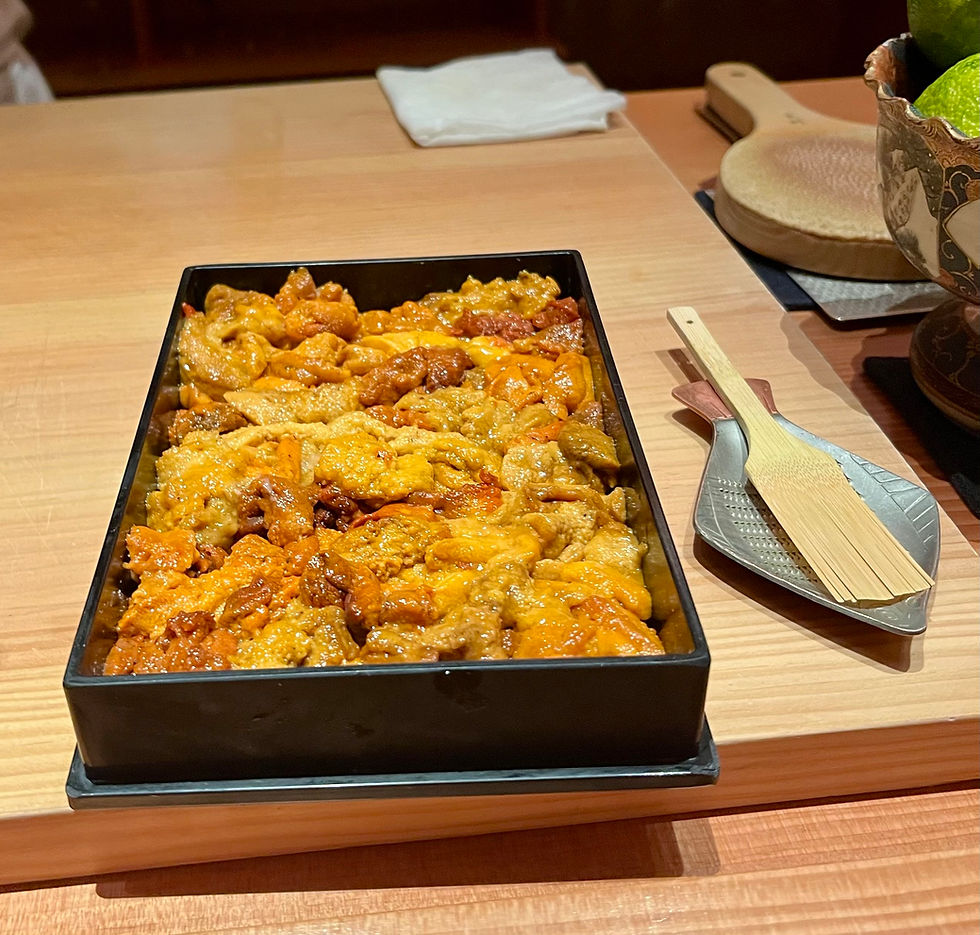
Uni from Iceland, a first for me! Lovely, but a little edgier in flavor than I prefer in sea urchin
Ankimo (monkfish liver) with chive and daikon

Anaba's take on tamago is notably sweet and delightfully Scandinavian––the egg custard is completed with langoustines rather than shrimp, and sweetened with the help of honey from local Danish hives. The resulting custard is cooked over charcoal for a smoky finish.
A green, minimal-waste ethos pervades fine dining in the Danish capitol, and Anaba uses the "leftover" parts of the seafood used for the omakase to fashion a lovely, smoky, intensely-flavored soup to close the savory portion of the meal. Warm and comforting on a chilly, damp Copenhagen night.

I've seen several takes on monaka, a Japanese sweet treat traditionally made with an azuki red bean paste sandwiched between two glutinous rice wafers, in recent fine dining forays, but this one takes the cake (or the monaka, if you will). Sweet pumpkin and savory chanterelle mushroom formed a bewitching filling for the crispy shell.

The fun didn't have to end after my meal, as they open their little lounge up to for diners from the first seating to enjoy a beverage after their meal. A host poured me a glass of Japanese whisky, and I enjoyed a conversation with some fellow Yankees who were awaiting their experience in the second seating while listening to the record player. Hygge, indeed.

I'm very glad I got to experience a convergence of two of my favorite foodways: New Nordic and omakase. Anaba is one of the truly unique experiences in Copenhagen, if not all of Europe. It's not in the realm of the finest sushi temples in Tokyo or New York, and not every bite was a hit, but everything is prepared soulfully and thoughtfully, with intentional ingredient sourcing and inventive bridging of two very different culinary traditions. I wouldn't hesitate to recommend Anaba to anyone visiting Copenhagen and looking for a cool, peripheral take on sushi omakase.
Up next: one last Asian-Nordic meal in Copenhagen, and a mind-bending dinner in London to cap off the autumn trip. Then we'll start digging in to the budding food scene in the sixth-largest metropolis in the US––Atlanta.


