Two Dinners in Milano – Autem and Ratanà

Phase two of my "Funemployment" journey took me across the pond and eventually to one of my favorite cities in Europe––and one of the most epic food cities in the world. Reveal forthcoming!
Finding myself suddenly unemployed and with a pending trip to the continent for a big family event, I tacked on a week in Italy for some "professional development"––tasting wine in one of my favorite wine regions in the world––Piemonte. After all, I had nowhere else I needed to be, and the disability checks were still coming in!
And so my first stop in Europe took me to a city in Italy I'd never happened to visit. Milan is the capital of Lombardia in the north-central part of the country, and is by far the largest metropolitan area in Italy, as well as the fourth-largest in Europe. It also happens to be the easiest major access point for international visitors to Piemonte, as it's just an hour by train to Turin and has three major airports.

Milan carries a reputation as the most "international" of the major Italian cities––while it still has a city center city full of European charm and magnificent storied architecture, it's otherwise quite modern, and is the epicenter of glamor and fashion in Italy. This has contributed to the development of a wonderful and diverse culinary scene, and I couldn't wait to sink my teeth into some of the best food the metropolis had to offer, even if I just had two night to explore––one before a little drive further west in Italy, and one after.

That's how I ended up at Autem my first night in Europe. After an aviation nerd bucket-list flight across the Atlantic on the upper deck of Lufthansa's Boeing 747-8, one of three major worldwide carriers to still operate the "Queen of the Skies," my connecting flight from Frankfurt deposited me at Milan's Linate airport, just fifteen minutes by metro from the center city, and craving something more interesting than the airline and airport lounge food that had sustained me for the previous 16 hours, I was ready to dive in to what some believe is one of the most exciting restaurants in Milan.

"Autem" comes from Latin, and can be translated as "and furthermore," which Chef Luca Natalini interprets as “the urgency of communicating something that has not yet been said.” Urgency is appropriate––the urgency of ingredients, in particular. Natalini views ingredients as ephemeral, existing in a fleeting moment of time. His love of beautiful ingredients takes him to the markets of Milan every morning in search of what is best. You can even book a cooking class with Chef that begins at the market looking for the best of the day.
The raw materials of dinner for the day are listed on a board at the entrance to the restaurant. Just like his grandfather, renowned Italian painter Carlo Maria Mariani, Chef Luca is an artist, and his ingredients are his medium.
“I don't choose the menu, the ingredients do.”
It was a bit of a schlep from my hotel to the happening Porto Romano neighborhood on the southeast ring of the city––the Milan metro system's broken elevators, residents indifferent to my obvious disability, and cobblestone sidewalks made the walk fairly challenging for someone with a sore ankle and a cane. I was relieved to come upon Autem just a few hundred meters from my metro stop and have a seat to rest.

I was sat with a fantastic view of the kitchen with an thoughtfully enigmatic plate reading "No idea is final" set at the table. Perusing their Instagram, it seems they have a series of plates with such phrases, a thoughtful and philosophical way to frame the dinner ahead.

I quickly ordered a vibrant glass of Franciacorta, Italy's answer to Champagne and some of the finest traditional method sparkling wine in the world. When in Lombardia!

Their menu, written by hand every day, is quite reasonably priced, even for a high-end experience, which I would find true throughout northern Italy. Besides the a la carte selections, I had the option of doing a chef's choice of smaller versions of six dishes off their daily-changing menu inspired by day's market selections, or an exploration of Chef Natalini's signature dishes. Given the primacy of ingredients here, I went for the seasonal menu. There was also an option to add some white truffles from Alba to a few dishes, so I had the kitchen choose two dishes to dust with shavings of the glorious tuber.

As usual of late, I forwent the wine pairings in favor of a bottle I brought, this time a fantastic chardonnay from my visit to Peter Michael just a few days before in Knight's Valley. The 2014 vintage was excellent, and the house specializes in distinctly California chardonnay, but still with vibrance owning to the chardonnay parcels' location at the top of the vineyard, allowing the ocean air to cool the fruit at night and retain acidity. It would prove to be perfect with the menu, in particular the truffled-up dishes!

Five tiny canapés on wood blocks of various heights graced the table first. I'll use this as an opportunity to apologize if and when descriptions of dishes are a bit incomplete––while I dabble, I am not an Italian speaker, and therefore I unfairly require restaurant staff to engage with me in English, so sometimes ingredients become lost in translation, or, perhaps "lost in accent."

Acknowledging also that the light is poor, from left to right, I enjoyed:
A tiny taco with anchovy and caviar
Tartlet with leek and cauliflower
A dish called “Visit to Paris,” a hollow macaron with beetroot
The one I didn't quite decipher––"Toscana, five minutes by car," with some sort of savory shortbread
A wafer sandwich with caramelized onion and herbs

Swiftly after these were cleared, bread service was offered, with a house-made seeded sourdough loaf and almost comically long and thin breadsticks––the most literal interpretation of "breadsticks" I could imagine. Cultured butter, salt, and pepper were also offered, but the best thing was an olive oil commissioned by Chef from a micro-producer in Toscana. Tipico!

The first proper course was a take on a Russian salad, something I'd be surprised to see on menus across northern Italy on this trip, with crunchy seasonal veg from the market and Ligurian shrimp topped with potato foam. A little dollop of caviar was a pleasant, briny surprise beneath the emulsion.

One of the most magnificent vehicles for white truffles is a simple poached egg, especially one as farm-fresh as those they source for Autem's menu. With a creamy foam surrounding and about five grams of truffle atop, it was the first of many dishes featuring white truffles I'd enjoy on this trip, and I couldn't have been happier. The Peter Michael chardonnay was particularly resplendent with this dish, providing a vibrant foil to the richness of the plated elements.


One of Chef's signatures, which was an optional add-on for a measly 10 Euros, was his "pasta in bianca," a manifestation of his penchant for whimsy and thoughtfulness in his food.

As you might notice, the cappellini looks just like it's described––white––with nothing more visible. Indeed, "you don't always see what you taste," the sommelier announces while placing the dish on the table. The pasta, looking plain, tasted anything but––Chef flavors the cappellini by soaking and then cooking it in a broth made with laurel, and then finishes it with a sauce made with Japanese vinegar and vermouth. Fantastic.
Plin, which in Piedmontese means "pinch," is a type of stuffed pasta reminiscent of agnolotti from the Piedmont stuffed with roasted meat. Autem's version uses duck, and atop were tiny pieces of barely-cooked langoustine and sprigs of a vibrant herb with which I was unfamiliar.


With the main course, I requested a red by the glass, and was offered a cabernet-dominant blend from Bolgheri in western Tuscany, where Bordeaux varietals are common––the soils in this wide, sloped plain near the sea aren't too dissimilar to those in Bordeaux, with alluvial sandy and clay loams rich in gravelly pebbles for good drainage. When the super Tuscan movement swept the region about 50 years ago, this area of Tuscany became the beating heart of the "new" style. The wine was red fruited and slightly spicy, but I regretted not going for the more traditional Lagrein offered out of the Coravin on the menu.
The main course would also be enhanced by white truffle, but was so fantastic on its own it probably didn't need it––not that I'm complaining about more truffles! Lamb saddle is one of my favorite cuts, and because of its fatty exterior, can get a marvelous crispy crust when cooked properly. Such was the case here, the crispy saddle garnished by purées of chestnut and yams as well as paper-thin slices of cauliflower and truffle.

I'd somehow attracted the attention of a gentleman, who introduced himself as a "restaurant investor" from Russia, and his rather unfriendly girlfriend on the other side of the dining room, and he was kind enough to do a little wine exchange with me––he'd ordered two exquisite bottles of wine from Toscana, and offered me a glass of each, which I repaid with a pour of the Peter Michael.
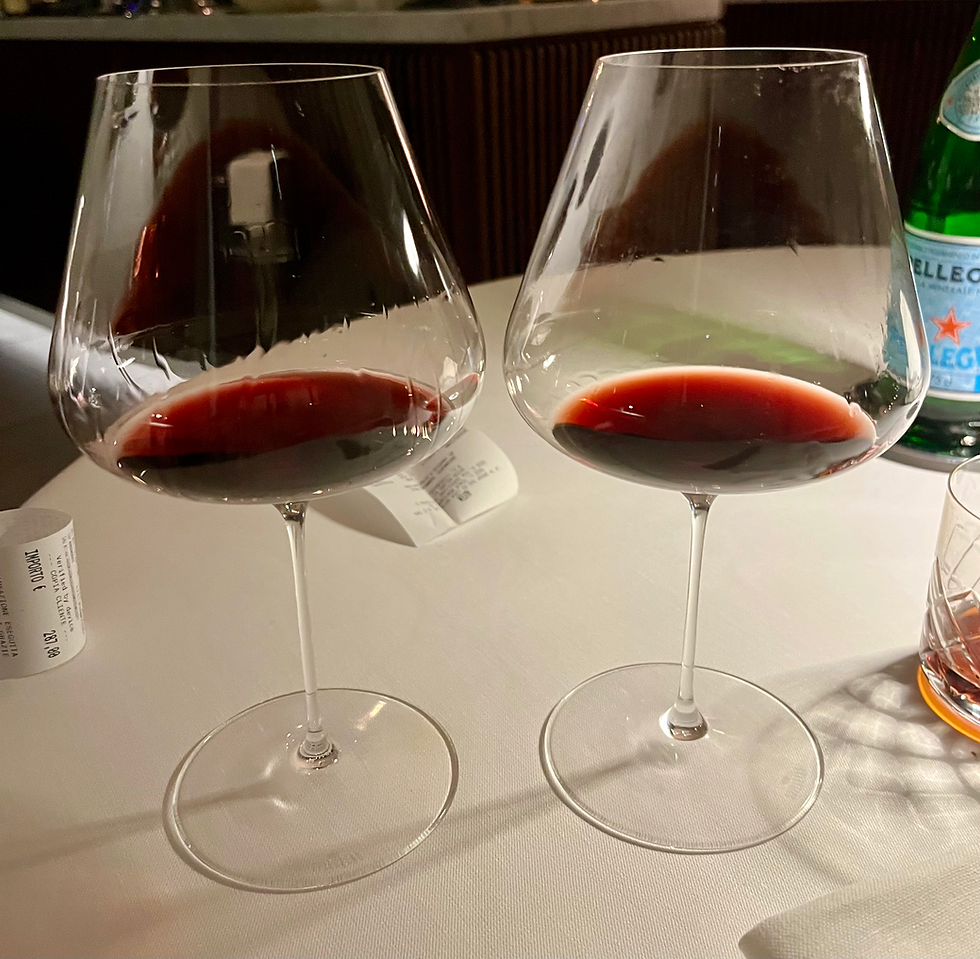
The first wine was a collaboration between Tuscan powerhouses Avignonesi and Capannelle called "50 & 50", the former of which offered merlot grown in the village of Montepulciano and the latter sangiovese from Gaiole, a historical subzone of Chianti Classico. A lovely balance of "old and new," with red fruit, violets, herbs, and a distinctly plush, hedonistic quality from the merlot.

Interestingly, any wine grown in Chianti that is 100% sangiovese cannot bear the "Chianti" or "Chianti Classico" designations, so these wines fall under the "Toscana IGT" label under Italian wine law. From Panzano, one of the most important areas of Chianti near Florence, this all-sangiovese bottling from Fontodi, called Flaccianello, was a decidedly modern expression of the varietal, aged in smaller barriques rather than larger neutral botti, but still distinctly sangiovese, resplendent with cherry-red fruit and dried Italian herbs. Despite his nearly-hostile girlfriend, I was grateful for the kindness of this dude sharing some of these fantastic Tuscan wines with me.

Dessert followed, first with a peach sorbet dressed with cacao nib and lavender to cleanse the palate, followed by a rich tart of dark chocolate, coffee, and chestnuts. A veritable smorgasbord of mignardises, for which I did not take notes, followed.
With the last bites, I added a pour of amaro, for which I've developed an affinity after manning the amaro cart at Aubergine. Santa Maria al Monte is a distinctly alpine amaro originally made by monks in Genoa on the Ligurian coast, and has a pronounced herbal, coniferous intensity, balanced by oak aging and fruity notes of rhubarb and bitter orange.

I'm really surprised that Autem flies so quietly under the radar in Milan. It's not on the Eater list, or any other online list of standout restaurants I used in my research––in fact, I only came across it by chance watching an American travel vlogger's overview of the best sights in town. This was a world-class meal––thoughtful, inviting, ingredient-driven, and expertly executed––at a very reasonable price.

As I departed, the chef de cuisine, who I'd gotten to chat with as he delivered several of my dishes to the table, quipped "a Michelin star next time you're here, maybe!" I can't think of any reason why not!
On the back end of the trip, I had a bit more time to explore Milan, though had similar issues navigating the city as hobbled as I was. After fighting through rush hour on the metro, I emerged right in front of the famous Duomo, the epicenter of the city, just as the last of the late afternoon light was waning.

Just across from the Piazza del Duomo is the famous Galleria, an open-air mall in the fashion capital of Italy. I had little interest in shopping, but was keen to visit Camparino in Galleria, a famous bar perched right at the entrance of the Galleria. This is a bar dedicated to Campari in the home city of the spirit, and for any serious foodie, a negroni prepared by the white tux–clad bartenders at Camparino is an unmissable experience. I was lucky enough to get a table on their enclosed patio with a view of the Duomo, turning orange with the last light of the sunset.


If Autem is one of the city's hidden gems, Ratanà, my choice for dinner this particular evening, is one of the city's most famous––Stanley Tucci dined here during the filming of his TV series on Italy. Hometown hero Chef Cesare Battisti is one of Milan's brightest stars, and opened Ratanà in 2009, committed to perfecting and elevating Milanese and Lombard cuisine, with a particular focus on the "raw materials," of the cuisine––not just the ingredients, but the traditions and people that have shaped it. Some dishes here are profoundly traditional and some playfully divergent from tradition, with Asian flavors like kimchi making regular appearances alongside storied Milanese recipes.

I was flabbergasted by the line outside the restaurant, housed in a standalone, stately villa in the Biblioteca degli Alberi Milano, a modern park flanked by one of the most famous buildings in Milan––the Bosco Verticale, a modernist residential development with forest-like gardens on nearly every surface. It was the opening of this building that started to bring more visitors to this otherwise obscure part of the city, propelling Ratanà to the status of culinary landmark.

Seems the place had just opened for the night and almost everyone in the queue had a reservation, so it took me a long while to get seated, and once I was, a rather absurd amount of time passed before I could get any attention from the waitstaff, which would prove to be a consistent problem throughout the meal––I'm sad to say I even witnessed some outright cruelty from some of the staff toward a pair of tourists at the bar who were having a hard time understanding the menu. Everyone was quite pleasant to me, however, even if they were a bit forgetful of my presence.
Once I finally caught someone's eye, I ordered a spritz made with one of my favorite amari, and one which was a regular hit on the amaro cart at Aubergine––Biancosarti, a white amaro from Bologna that shows cascades of bitter lemon, lemongrass, fennel, and hazelnut. I was so happy to see this on a menu; with soda and a spring of rosemary, it was a dream, and I ended up devouring three of them.
I love the design of the menu at Ratanà. All the dishes are built to share, so I was at first dismayed that I'd either end up ordering far too much food or not get to sample much. But their "tasting menu," priced at a flat 70 Euro, allows you to select literally any four dishes on the menu, prepared in a smaller size so that the overall meal is perfect for one person.

Anticipating meaty northern Italian dishes, I brought a bottle of red wine which I acquired in Piemonte the week before (writeup forthcoming)––a very traditional bottling of Barolo from Brezza, sourced from a cru right behind the famous Cannubi vineyard. Called Sarmassa, it was my favorite single-vineyard expression from my visit to Brezza, offering a bit more generosity of fruit due to the vineyard's lower elevation which keeps the fruit a bit warmer during the growing season and allows for earlier ripening. From 2013, a great vintage, it had enough age to soften the sharper edges of Barolo tannin but still had wonderful structure and nebbiolo perfume.
I started with an elevated take on a distinctly Milanese dish which can be found in various street markets and casual spots around town––fried meatballs called mondeghili, served street food–style in a paper cone with a traditional Milanese gremolata for dipping. Delicious.

Ratanà's breadsticks are called "addictive" on their menu, and can be ordered with multiple different selections of accompaniments. The server suggested a goose salami accoutrement with borrettane onions braised in balsamic vinegar. The dish was dusted with shavings of horseradish root that resembled cheese, a playful element. The breadsticks weren't as scrumptious as I anticipated, but I loved the salami and onion companions.

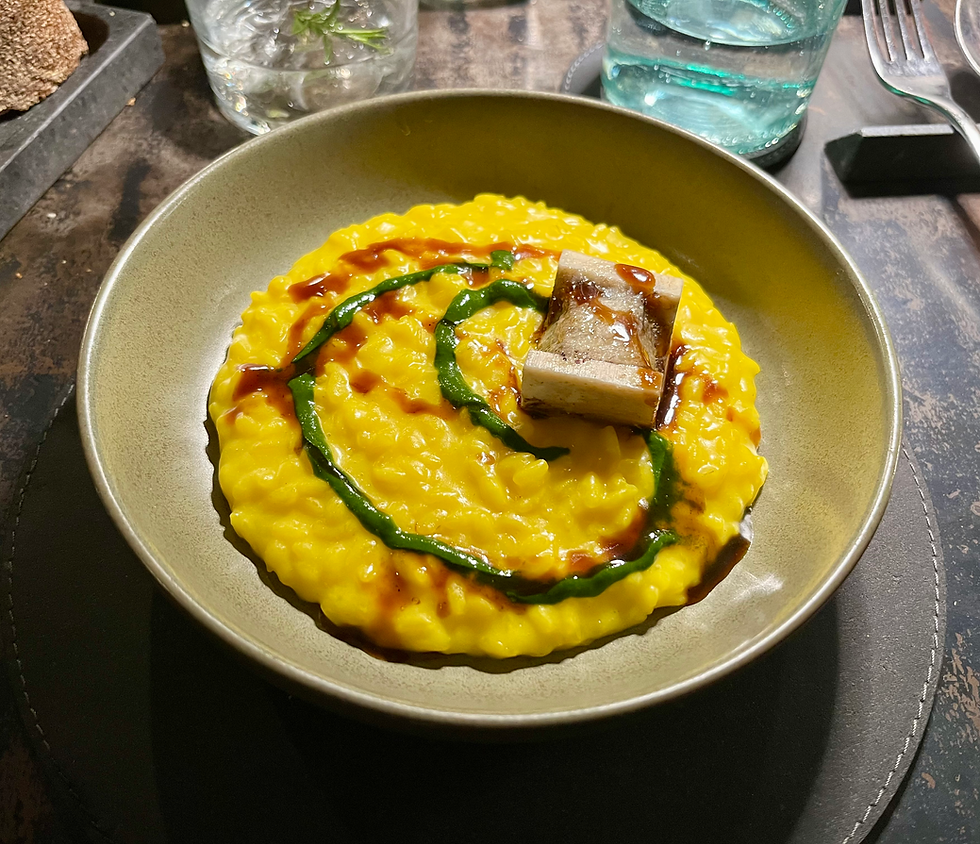
But it was the third dish for which I made the journey to this neighborhood––Chef Cesare's take on risotto alla Milanese. A creamy saffron-based risotto, Battisti's version is served with a small helping of veal bone marrow and drizzled with gremolata. It's one of the city's most celebrated dishes, and for good reason; I thought about ordering another plate.
I realized that I'd been in northern Italy for a week and hadn't yet enjoyed any of Piemonte's famous beef, a variety of cattle called Fassona. Known for producing lean beef with immensely rich flavor and remarkable tenderness, Fassona beef is some of the most celebrated in the world. I misread, or misunderstood, the menu and ordered a Fassona tenderloin dish with salted egg yolk sauce, lodigiano cheese, and radicchio, but it turned out to be a raw carpaccio rather than a cooked beef dish. Still, quite delicious, especially with the last sips of the Barolo.

Dessert was one of the hits of the night, and an autumn signature for Ratanà's pastry team. Whipped sweet goat cheese was served with a glaze of Bourbon vanilla with candied persimmons and a hazelnut crumble beneath. With a final neat pour of Biancosarti, it was a killer way to end the meal.

Despite the service issues, I can see why Ratanà is an icon of Milan's culinary scene, and I would not hesitate to return or recommend it to anyone––I'd return just for a plate of that risotto alone! Next time, I'll pre-order the Milanese veal chop, one of their signatures.
My evening ended with a visit to Moebius, now listed as no. 7 worldwide on Pellegrino's Top 50 Bars, and it just happened to be right around the corner from my hotel. My phone died just minutes after my arrival, so I didn't get any pictures, but the drinks were fantastic and the bartenders amicable and talented.
I look forward to a future visit to Milano, when I'll hopefully get to explore the city's diverse food landscape more comprehensively––hopefully this time not inhibited by an ankle injury. But if either of my loyal readers find themselves in Italy's largest city, consider a visit to either of these fantastic eateries for some of the best of what the metropolis has to offer.


