Tasting Wine in Barolo

Updated: Jan 27
"Nebbiolo invites food––the acid, the tannin. You can feel it on the palate."
Enzo Brezza is the fourth generation winemaker of his family's cellar in the town of Barolo. He looks straight out of central casting for an Italian winemaker––newsboy hat, earth-tone sweater and trousers, skin permanently tan and hands rugged from work in the vineyard. I'm sat at a table adjacent to Brezza's cellar with an Italian couple, absorbing as much of Enzo's brisk, poetic Italian as I can. A dozen bottles of his Piedmontese wines are open on the table in front of us for our consideration.

Enzo pauses and sips his glass of his most recent expression of Barolo's famous Cannubi vineyard, a site called "the most famous hill in Italy." The Barolo is young, the tannins robust, and his lips tighten before forming a subtle grin. More Italian: "Niente pinot noir. Niente cabernet. Only nebbiolo has this dance of tannin and acid."
You'd hardly realize you're about to enter one a world-class wine region when approaching the Langhe by road from the northwest. The Autostrada pierces south from Turin like an arrow, with little but flat industrial and agricultural land extending in every direction. The dense smog conceals the feet of the mountains to the west, the jagged peaks of the Cottian Alps seeming to float in the late autumn sky.
The Italian wine region of Piemonte, meaning literally "foot of the mountains," is tucked in the foothills in the northwest of the country, roughly equidistant between provincial capital Turin in the north and the Ligurian coast in the south. Surrounding the city of Alba is the Langhe, the epicenter of nebbiolo production in Italy and the world, in which Barolo and Barbaresco are the most famous sub-regions and some of the most famous geographies for wine on the planet. It would become my second winemaking region to visit in Europe for a trip dedicated to tasting wine, and my first in Italy.
Fog is ubiquitous in this part of the country. The Alps form the west and north sides of the basin, and the Apennines and Ligurian Sea to the south keep air contained within it. As the corridor between Milano and Turin became Italy's industrial beating heart, smog replaced the fog, and the air is tinged with a constant haze, particularly in the colder months. Nebbiolo, the region's most important grape, likely gets it name from the heavy, translucent air here––in Italian, fog is "nebbie."

Exiting the highway and climbing slowly toward the spine of the highest point in the Barolo subzone toward the village of La Morra, the land suddenly drops to the east of the road, revealing a boundless sea of vineyard land. It's a breathtaking sight––rolling hills covered by vines interrupted only by picturesque medieval villages and dense oak forests. The horizon is obscured by the saturated air, giving the land below you a sense of limitlessness.
In Piedmontese, Langhe means "tongue," referring to the shape of the series of rolling slopes descending northward toward the Tanaro river. Each slope generates different aspects for grape-growing––the southwest- and southeast-facing slopes collecting more sun and warmth throughout the growing season.

"This is where we grow nebbiolo." I'm strolling through a microscopic vineyard, or cru, on a southeast-facing slope just below La Morra on the western side of the Barolo subregion with Giovanni, a young local in the employ of Ghëddo, among the most exciting newer producers in Barolo. He points to the south: "Nebbiolo needs the sun. It buds early, and it ripens late."

There are 181 recognized crus, or more properly MGAs (Menzione Geografica Aggiuntiva) in the Barolo subregion, most of which are owned and farmed by multiple wineries. Nebbiolo's sensitivity to terroir and the increasing emphasis on single-vineyard sites in the region means that Barolo (and its neighbor, Barbaresco) is second only to Burgundy in terms of precise subdivisions of vineyard land. The most important crus for nebbiolo––Cannubi, Monprivato, Ravera, or Sarmassa, for example––all have some degree of tilt toward the south.

"On the north-facing sites, we grow dolcetto," Giovanni mentions, referring to the "other" great grape of the Langhe. Dolcetto needs comparatively less sun, producing wines with rusticity but gentler tannin, lower acid, and more lush fruit. Barbera, meanwhile, another prominent Piedmontese red, tends to occupy the vineyard land surrounding the towns of Alba, Asti, and Nizza, and is otherwise uncommon in Barolo and Barbaresco.

"Dolcetto is the wine we bring to dinner on a weeknight," Giovanni laughs. "Barolo is for special times." Huddled up in their microscopic tasting room in an old stone building amongst the vines, I quaff Ghëddo's dolcetto. It's not as layered and structured as their Barolo, but it's hardly a simple wine––it brims with perfumed complexity, resembling roses and purple flowers, and drinks like velvet punctuated by a hint of gritty earth. I asked for a bottle to take home and was set back less than 20 Euro.
From the ridge approaching the village of Serralunga d'Alba from the south, you have a perfect view of Castiglione Falletto on the next ridgeline, and the village of La Morra looms high above on the hazy horizon to the northwest. This, along with the edge of the belvedere of La Morra looking east, is one of the finest views over the Barolo region.

Elevation is critical in Barolo, both above and below ground. Above ground, vineyards at higher elevations are subject to slightly lower temperatures and some residual cool air from the Cottian Alps, while lower elevations collect more heat and encourage ripening. But far more important is elevation's contribution to what happens below the ground––the soil composition.

In La Morra, the highest village in Barolo, the soils are younger, sandier, looser, and slightly more nutritious, producing wines with more perfume, lighter body, and gentler tannin. Meanwhile, on the other end of Barolo, in Serralunga d'Alba, you are lower in elevation, and the soils are older, with significant density, a higher percentage of clay and limestone, and fewer nutrients, requiring more struggle for the vines and yielding wines with more tannin, concentration, and intensity. Wines from Castiglione Falletto, on the intermediate ridgeline, or the village of Barolo, in a valley below La Morra, sit somewhere between.
Because of harvest and truffle season, autumn sees the highest number of tourists to Piemonte, and there are frequent events for locals and visitors alike. On autumn Saturdays at Cantina Comunale de La Morra, a wine shop and art gallery in the center of the village, you can taste wines from a sampling of about a dozen producers, the Barolos all from the vineyards surrounding the village. Twenty Euro gives me access to all the elegance and perfume that La Morra has to offer.

No producer's wines intrigue me quite like Burzi's. Winemaker Alberto Burzi looms over the diminutive table on which he humbly offers a few of his bottles for the consideration of the packed gallery. A taste of his 2021 Capalot vineyard Barolo is among the most compelling wines I'd sampled on the trip––despite the wine's youth and the penchant for featherlight expressions of nebbiolo in La Morra, this wine displays a terrific ripeness with more generosity of fruit than I'm used to from the village while still harnessing its classic perfume.

"It's all about ripeness," Alberto chimes in, seeing my expression of joy as I quaff his handiwork. "Knowing exactly when the fruit is ready." I'd later watch a YouTube video with Alberto and his wife in the Capalot vineyard discussing various trellising techniques they'd been testing, some just marginally different from the next, for optimal sun exposure for ripening. This level of precision is exactly what allows Burzi to produce wine of such impossible balance.

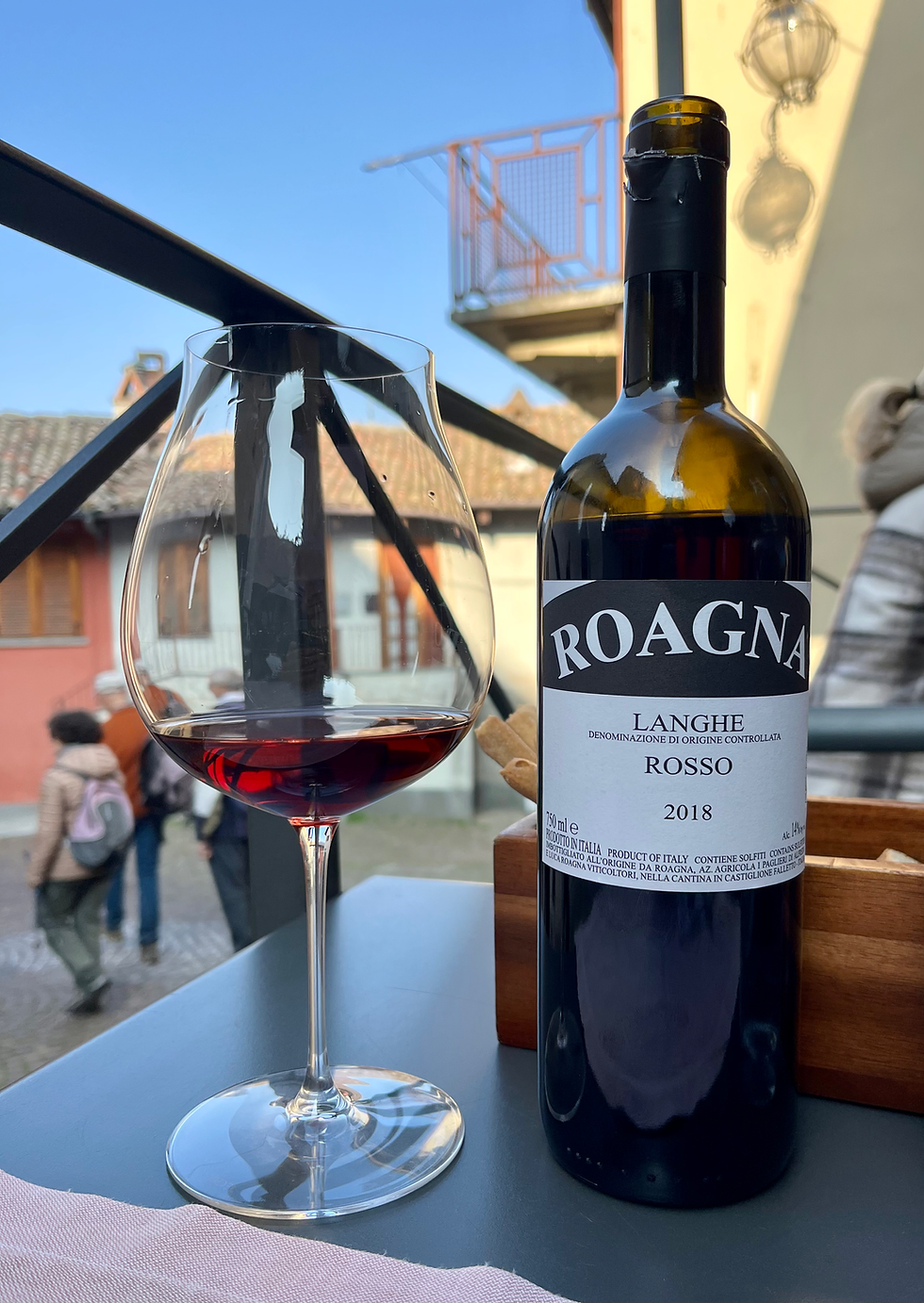
The next day, I'm in Serralunga enjoying a glorious helping of tajarin, a local Piemontese pasta, with heaps of shaved Alba white truffle paired with a bottle of Langhe nebbiolo from Luca Roagna, one of my favorite producers. I strike up a conversation with a local couple who visit Serralunga at least weekly just to stop by this particular restaurant. I tell them that I'm off to enjoy a tasting at Massolino, just down the hill and perched on the edge of the village, and they excitedly mention that Massolino is among their favorite producers in the area. They join me on my walk down to the winery and order a bottle or two to take home while I embark on my tasting.

Massolino enjoys extensive penetration in the American wine export market, but there's no substitute for a visit. The family's winery and soul are both in Serralunga d'Alba, and they own vines in some of the greatest vineyards in the village––famously, Giuseppe Massolino traded for a small parcel of Vigna Rionda (also spelled Vignarionda), possibly the most exceptional cru in Barolo, for another parcel twice the size. These days, Massolino owns a significant portion of the vineyard.
Vigna Rionda is quintessentially Serralunga and sits on the oldest soils in Barolo from the Lequio Formation, some 11 to 13 million years old. Rich in limestone and clay, the soils produce wines of ineffable complexity and robustness. It's a small picture of the broader village, an area which produces some of the most intense and brooding wines of the region, all within the frame of nebbiolo's fundamental grace.

My host at Massolino breaks out a couple of their single-cru Barolos after learning that I'm in the business. The Margheria shows the magnificent tension of Serralunga fruit––there is immense structure, yes, but boundless vibrance wrapped in cascades of red fruit, flowers, and truffles. An offering from Castiglione, the Parussi cru, shows the more even-handed, balanced profile of the middle village, with a more forgiving structure and brighter fruit. I shyly ask if a taste of the Vigna Rionda might be on offer, and she just giggles and shakes her head––"I'd lose my job."
I'd get a chance to indulge in a glass of Vigna Rionda while wandering the village of Barolo on a sunny afternoon. Tucked under the shadow of the hillside that forms the Cannubi vineyard, La Vite Turchese might be one of the most legendary wine bars in the world. Proprietor Stefano is a consummate wine pro and the depth of his knowledge extends well beyond the wines of Italy. Over the course of four hours there, we would nerd out about grower Champagnes, share deep cuts from our visits to La Rioja, and trade stories about when we each met Cathy Corison.

But you come here for nebbiolo. Stefano and team have created possibly the most comprehensive by-the-glass list in the world using the Coravin, a device that allows for a pour from a bottle without opening it by inserting a needled through the cork and replacing the wine it removes with inert argon gas. It's an imperfect system but one that the staff at Vite Turchese have used to offer guests an unparalleled lineup of wines to sample, particularly local offerings.
Bellying up to the counter, Stefano himself might welcome you. "Can I see the menu?" "I am the menu!" Ask what he's most excited about by the glass and he will select from dozens of Coravined bottles. This afternoon, price was no object, and he smirked, hustled to the cellar, and returned with a bottle of Vigna Rionda.
The most epic expressions of Vigna Rionda came from Bruno Giacosa, but he stopped making the wine in 1993. His apprentice, Dante Scaglione, is now the winemaker for Luigi Oddero, and just a year ago he released possibly one of the greatest permutations of Vigna Rionda Barolo of the century. Sourcing from a south-facing parcel low on the hill, Dante waited until a truly exceptional vintage, 2013, and carefully aged the wine in barrel and bottle for eight years. The result, paired with cheese and charcuterie curated by Vite Turchese, is some of the most magnificent Barolo you can find.

It's all too easy to order another glass. From a magnum, Stefano offered a glass of Cannubi San Lorenzo from Ceretto. He points out the window at the imposing hill of vines beyond––"Right there." Exhibiting the balance of Cannubi and the rustic undertones of a wine with age, it was magnificent, possibly even better than the Vigna Rionda.

I was having such a wonderful time that I'd forgotten I had a reservation at Borgogno, just around the corner, that afternoon. By now, the couch in the corner of the room was open, Stefano had a plan for me, and I had given him carte blanche with my credit card. From Manzoni's favorite parcel, Gramolere, in Monforte d'Alba, southwest of Serralunga but a bit higher, the next wine was released in 2025 to commemorate the family's 100th anniversary as winemakers. This was aged for seven years in neutral botti and another five in concrete before four more years in bottle. Two-thousand-and-nine was an otherwise marginal vintage, but Manzoni would make sure their riserva from the vintage was anything but.

Two classic wines from epic producers followed––Angelo Gaja's Barbaresco bottling from 2017, representing probably the most important producer of wines from Barolo's sister region to the east, and Giuseppe Mascarello's Monprivato from 2020. I ordered the Gaja; the Mascarello was a surprise––I laughed aloud when Stefano arrived with the bottle. "Normally, Monprivato is shy: 'No, don't touch me!' But in 2020, it says 'Make me your bitch.'"
Stefano saved a selection from 1995 in magnum to close, a vintage of high quality, but also extensive hail damage. Fratelli Oddero's "Emprimer" Barolo was poured out of magnum, a 30 year-old expression that shows the magnificent potential of nebbiolo to age. An afternoon I will not soon forget.
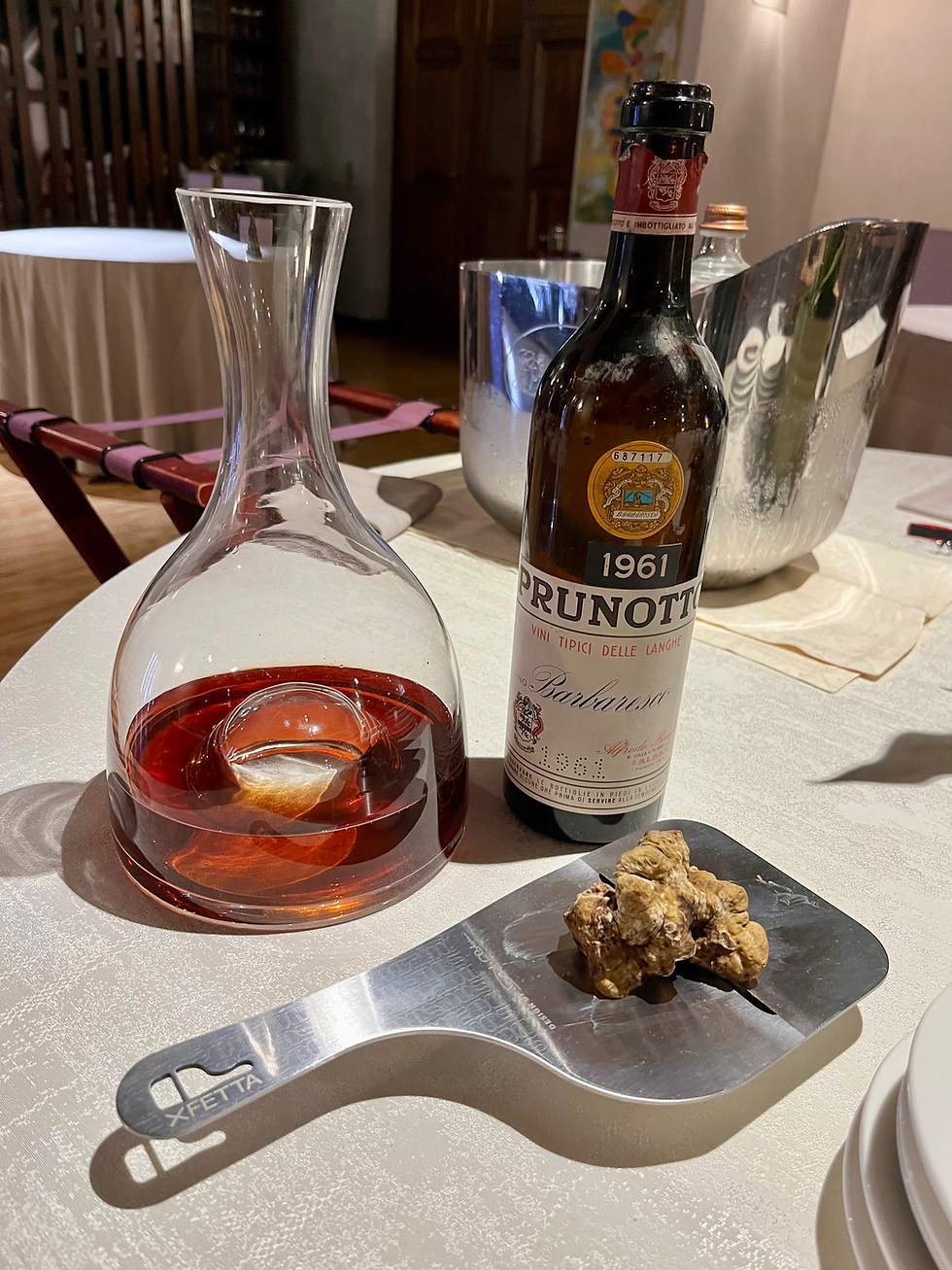
I have no will to pack my bags and my head is heavy when my alarm sounds on my last morning in Piemonte. The night before was a magical whirlwind of decades-old nebbiolo and white truffles––I found in a local shop a pristine bottle of Prunotto Barbaresco from 1961, a legendary vintage from the earliest years of the modern winemaking era in Piemonte, to pair with a terrific white truffle–centric tasting menu at Michelin-starred Ristorante 21.9. The evening felt like a fever dream of Piedmontese comestible magnificence.
Gripping my coffee mug, I gaze west over the first light on the vineyards of Castiglione Falletto from my hotel balcony, overtaken by awe and melancholy at once; I wasn't ready to leave.

Before making the schlep back to Turin and onward to Milano, a final winery visit was in order, just at the bottom of the hill as the road exits the ridge that descends from Castiglione. Paolo Scavino is another storied house with significant presence in the export market. Here, the wines are pure distillations of the manifold terroirs in Barolo––they source fruit from multiple crus, but make the wines identically, using the same types of botti, the same amount of time in barrel and bottle, and otherwise the same winemaking processes, allowing the terroir to be as expressive as possible.

Scavino also serves as an example of a winery that succumbed to the "Robert Parker Effect" back in the 80s, switching from traditional neutral oak botti to new French barriques and favoring more ripeness and extraction to make their wines congruent with the prevailing international style of the era. Mattei, our host, shows off the Slavonian oak botti in the cellar, and I nudge and point his attention toward the derelict barriques in a distant corner with a knowing smile. He says simply, "From a lesser time" before continuing the tour.
Indeed, Barolo has in many ways come back to its roots––large, neutral oak botti and extended extractions are once again fashionable, and new French oak is scant in serious cellars. But any winemaker here will tell you that the modern innovations in winemaking, many of which were brought to the region by the cosmopolitanization of wine in the '80s and '90s, have done wonders for the quality of wines in Barolo in recent decades, even as the traditional practices come back in vogue.
And producers are increasingly responding the the market's demand for wines that are drinkable in their youth rather than needing time in a cellar for years or even decades; tannin management in the cellar and precise understanding of phenolic ripeness in the vineyard is at its apex, and generally warmer vintages offer fruit that promises increasing approachability.

What is perhaps most modern about Barolo is the increasing emphasis on individual and ever-smaller terroirs, a concept that is all the rage in wine these days. Indeed, "classic" Barolo harnessed the winemaker's skill at blending to capture the perfect ensemble of various crus and parcels from any number of the eleven villages of Barolo to produce wine; it's only in the last few decades that houses in Barolo have taken a cue from their Burgundian counterparts in highlighting individual terroir in their bottlings.

A tasting at Paolo Scavino offers an unbridled look at the nuances of terroir in this multifaceted region. After a lively Langhe Nebbiolo bottling and a "classico" blended Barolo, four very different expressions of single-cru Barolos follow. Mattei reminds us that the vintage and the winemaking are the same for each wine––"The differences you are tasting are just the terroir."
I leave Paolo Scavino armed with a bottle of their signature cru, Bric dël Fisac, from a monopole just to my right as I exit. I wind my way back up the hill to La Morra's ridgeline. The rippling hills that surround me are nearly completely covered in vines, some of which have been producing the fruit for some of the most coveted wines in the world for decades.
As I crest the ridgeline and exit toward the Autostrada, the pyramid-like peak of Monviso emerges prominent far to the west. Just 250 kilometers away almost directly over the peak of Monviso is the epicenter of yet another of the world's great wine regions––the Northern Rhône. It's a reminder how concentrated excellent wine is in this part of the world, and an invitation to one day traverse those Alpine valleys and emerge on the other side to explore all of what France has to offer as well.


